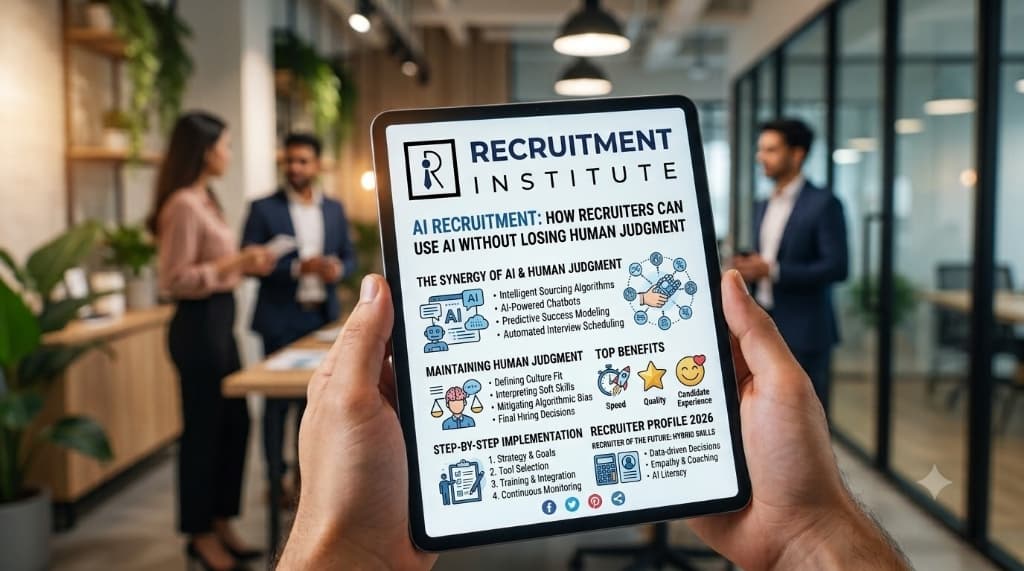
AI Recruitment: How Recruiters Can Use AI Without Losing Human Judgment
Want to become a recruiter in India in 2026? Recruitment is one of the few career fields where you can start with a degree in almost any discipline, develop your skills through practical experience and build a career across industries such as IT, healthcare, BFSI, manufacturing, retail, engineering, consulting and startups.
The role of a recruiter has also changed significantly.
Recruiters are no longer expected to simply collect resumes and arrange interviews. Modern recruiters are expected to understand business requirements, find suitable candidates, use recruitment technology, communicate effectively with hiring managers, analyse recruitment data and increasingly use artificial intelligence to improve sourcing and screening.
That makes 2026 an interesting time to enter the recruitment profession.
Whether you are a fresher, graduate, HR professional, career changer, staffing professional or someone planning to start a recruitment business, this guide explains how to build a career as a recruiter in India.
What Does a Recruiter Do?
A recruiter helps an organisation identify, attract, evaluate and hire suitable candidates for its vacancies.
The actual work can vary depending on the organisation and recruitment model, but a recruiter may typically handle:
- Understanding job requirements
- Preparing or analysing job descriptions
- Searching for candidates
- Sourcing profiles from job portals and professional networks
- Screening resumes
- Conducting initial candidate conversations
- Coordinating interviews
- Maintaining candidate records
- Following up with candidates and hiring managers
- Negotiating or coordinating offers
- Managing candidate joining
- Maintaining recruitment reports
- Supporting employer branding
- Building talent pipelines
For example, an IT recruiter hiring a Java developer may need to understand concepts such as Java, Spring Boot, Microservices, SQL, REST APIs and cloud technologies well enough to identify relevant profiles.
The recruiter doesn’t necessarily need to be a software engineer.
However, they need enough domain knowledge to distinguish a relevant candidate from an irrelevant one.
That is why modern recruitment is increasingly becoming a specialised profession rather than an administrative HR activity.
Is Recruitment a Good Career in India in 2026?
Yes, particularly for people who enjoy communication, networking, problem-solving and working with people.
Recruitment can offer several career paths.
You can start as a:
Recruitment Intern → Recruitment Executive → Recruiter → Senior Recruiter → Talent Acquisition Specialist → Talent Acquisition Manager → Recruitment Head
There are also alternative paths.
A recruiter can move into:
- Talent acquisition
- HR operations
- Employer branding
- Recruitment consulting
- Executive search
- RPO
- Staffing
- Recruitment technology
- HR analytics
- Recruitment training
- Recruitment entrepreneurship
Another advantage is that recruitment experience can be developed across industries.
A recruiter may begin with non-IT hiring and later move into IT recruitment, executive search, healthcare recruitment, engineering recruitment or international recruitment.
Who Can Become a Recruiter?
One of the most attractive aspects of recruitment is that there isn’t one compulsory academic background.
Graduates from backgrounds such as:
- BBA
- BCom
- BA
- BSc
- BTech
- MBA
- Psychology
- Sociology
- Commerce
- Management
- Engineering
can enter recruitment.
An HR or MBA background can certainly be helpful, but it is not the only route.
A person with strong communication skills, curiosity, discipline and the willingness to learn can build a successful recruitment career.
For freshers, the most important thing is not collecting multiple certificates.
It is developing practical recruitment skills.
Step 1: Understand the Recruitment Process
Before applying for recruiter jobs, understand the complete recruitment lifecycle.
A typical recruitment process looks like this:
Requirement → Sourcing → Screening → Shortlisting → Interview → Selection → Offer → Joining → Onboarding
You should understand what happens at each stage.
For example, suppose a company gives you a requirement for five software developers.
You should be able to understand:
- What exactly is the company looking for?
- Which skills are mandatory?
- Which skills are desirable?
- How much experience is required?
- What is the salary range?
- Where is the position located?
- Is it remote, hybrid or office-based?
- What is the notice period requirement?
- What type of candidate is likely to accept the role?
Recruitment begins with understanding the requirement, not with searching resumes.
Step 2: Develop Strong Candidate Sourcing Skills
Sourcing is one of the most important skills for a recruiter.
A recruiter must know where suitable candidates are likely to be found.
Common sourcing channels include:
- Job portals
- Employee referrals
- Recruitment databases
- Professional communities
- Social media
- Campus recruitment
- Recruitment agencies
- Industry networks
- Existing talent pools
However, simply searching for candidates is not enough.
You need to learn how to search intelligently.
This is where Boolean search becomes extremely useful.
For example, an IT recruiter searching for Java developers may use combinations of terms such as:
("Java Developer" OR "Java Engineer") AND (Spring OR "Spring Boot") AND (Microservices OR "Micro Services")
The objective is not to create complicated search strings.
The objective is to find the right people faster.
Step 3: Learn Resume Screening
Receiving 300 resumes doesn’t mean you have 300 potential candidates.
A recruiter needs to quickly determine which profiles deserve further evaluation.
Learn to identify:
- Technical relevance – Does the candidate have the required skills?
- Experience relevance – Has the person worked in a similar role?
- Industry relevance – Does the candidate understand the relevant business environment?
- Career stability – Are there frequent unexplained job changes?
- Location – Can the candidate realistically work from the required location?
- Compensation – Are salary expectations compatible with the position?
- Notice period – Can the person join within the employer’s timeline?
- Career motivation – Is the candidate genuinely interested in the opportunity?
Good recruiters don’t just read resumes.
They interpret them.
Step 4: Improve Your Candidate Communication
Recruitment is a people business.
You can have excellent sourcing skills and still struggle if you cannot communicate effectively.
A recruiter communicates with:
- Candidates
- Hiring managers
- HR managers
- Business leaders
- Interview panels
- Clients
- Vendors
- Recruitment partners
You should learn how to:
- Introduce a job professionally
- Explain an opportunity clearly
- Ask relevant screening questions
- Handle candidate objections
- Discuss compensation professionally
- Follow up without irritating candidates
- Communicate rejection respectfully
- Maintain relationships with candidates
Good communication does not mean using complicated English.
It means being clear, professional, respectful and confident.
Step 5: Learn Interview Coordination and Candidate Assessment
A recruiter is usually not the final decision-maker.
However, recruiters play an important role in ensuring that the right candidates reach the hiring manager.
You should understand:
- Screening interviews
- Competency-based questions
- Behavioural questions
- Technical screening
- Cultural fit
- Candidate motivation
- Interview scheduling
- Interview feedback
- Selection decisions
For specialised roles, you should also learn enough about the profession to understand what the hiring manager is looking for.
A recruiter hiring a sales manager should understand sales terminology.
A recruiter hiring a software developer should understand basic technology terminology.
A recruiter hiring an accountant should understand common accounting concepts.
You don’t need to become an expert in every profession.
You need enough job knowledge to recruit intelligently.
Step 6: Learn Recruitment Technology
Recruitment technology is becoming increasingly important.
In 2026, recruiters may work with:
- Applicant Tracking Systems (ATS)
- Recruitment CRM systems
- Job portals
- LinkedIn Recruiter
- Candidate databases
- Video interview platforms
- Assessment platforms
- HRMS systems
- Analytics dashboards
- Recruitment automation tools
- AI-powered recruitment applications
Therefore, becoming comfortable with technology can give you a major advantage.
A recruiter who can organise candidate data, automate repetitive tasks and analyse recruitment metrics can often work more efficiently than someone who relies entirely on spreadsheets and manual follow-ups.
Step 7: Learn How AI Is Changing Recruitment
Artificial intelligence is becoming one of the most important developments in recruitment.
AI can assist recruiters with activities such as:
- Job description drafting
- Resume summarisation
- Candidate matching
- Sourcing
- Interview question generation
- Candidate communication
- Recruitment reporting
- Market research
- Recruitment analytics
- Workflow automation
But there is an important distinction.
AI should support recruiters, not replace professional judgement.
A candidate shouldn’t be rejected simply because an automated system failed to recognise a relevant skill.
Recruiters still need to evaluate context, communication, motivation, experience and suitability.
This means the recruiter of 2026 needs two types of capability:
Human skills + technology skills
That combination can become a significant career advantage.
Step 8: Understand Recruitment Metrics
If you want to move beyond an entry-level recruiter position, learn recruitment metrics.
Common recruitment metrics include:
- Time to hire
- Time to fill
- Cost per hire
- Source of hire
- Offer acceptance rate
- Interview to selection ratio
- Joining ratio
- Candidate dropout rate
- Quality of hire
- Recruitment funnel conversion
For example:
If 100 candidates are sourced, 30 are shortlisted, 15 attend interviews, 5 receive offers and 4 join, you should understand what happened at each stage.
Recruitment is becoming increasingly data driven.
A recruiter who can explain recruitment performance using numbers becomes more valuable to management.
Step 9: Choose Your Recruitment Specialisation
You don’t have to remain a generalist throughout your career.
After gaining basic experience, consider developing a specialisation.
Some popular areas include:
- IT Recruitment – Hiring software developers, engineers, architects, testers, DevOps professionals, data specialists and technology leaders.
- Non-IT Recruitment – Hiring for sales, finance, administration, operations, retail, customer service and other business functions.
- Talent Acquisition – A broader function involving recruitment strategy, employer branding, workforce planning and talent pipelines.
- Executive Search – Recruiting senior-level and leadership professionals.
- Staffing – Managing temporary, contract or workforce requirements.
- International Recruitment – Recruiting candidates for overseas employers.
- Campus Recruitment – Hiring students and fresh graduates.
- Recruitment Consulting – Helping companies design and improve their hiring strategies.
- Recruitment Entrepreneurship – Building your own recruitment agency or consultancy.
Specialisation can help you develop stronger market credibility and command better opportunities.
Step 10: Get Practical Experience
This is where many aspiring recruiters make a mistake.
They complete a course and immediately expect a job.
Training is useful but employers ultimately want evidence that you can perform recruitment activities.
Create a practical portfolio.
For example, prepare:
- A sample job description – Create a professional JD for a real role.
- Boolean search strings – Create Boolean searches for five different positions.
- Candidate sourcing exercise – Identify hypothetical candidates for a requirement.
- Resume screening sheet – Create a candidate evaluation template.
- Screening questionnaire – Prepare questions for a recruiter screening call.
- Recruitment tracker – Create a simple candidate pipeline.
- Interview coordination workflow – Document how you would move candidates through the interview process.
- Recruitment dashboard – Track sourcing, interviews, offers and joining.
This gives you something concrete to discuss during interviews.
What Qualification Is Required to Become a Recruiter?
There is no single mandatory qualification for every recruiter position in India.
Employers may prefer graduates, while some positions may specifically ask for HR or management qualifications.
A degree can help you meet eligibility requirements.
However, recruiters are generally evaluated heavily on practical skills and performance.
For a fresher, a combination such as:
Graduation + Recruitment Training + Practical Projects + Communication Skills
can provide a strong starting point.
For experienced HR professionals, specialised recruitment or talent acquisition training can help build expertise in areas such as sourcing, technology, AI and recruitment analytics.
How Much Can a Recruiter Earn in India?
Recruiter compensation varies substantially depending on experience, location, industry, specialisation, employer and performance.
A fresher will generally start at a different level from an experienced IT recruiter or Talent Acquisition Manager.
Recruiters working in specialised technology recruitment, executive search, international hiring or recruitment consulting may have different earning opportunities from general recruitment roles.
In addition to fixed salary, some recruitment positions—particularly agency and staffing roles may include incentives or performance based earnings.
Therefore, don’t choose recruitment purely because of a salary figure.
Think about the career path.
A person who develops strong sourcing, stakeholder management, technology and business skills can progress significantly beyond an entry level recruiter position.
Recruiter Career Path in India
A possible career progression could look like this:
Recruitment Intern → Recruitment Executive → Recruiter → Senior Recruiter → Talent Acquisition Specialist → Talent Acquisition Manager → Recruitment Lead / Recruitment Head → Head of Talent Acquisition / HR Leadership
Alternatively:
Recruiter → Recruitment Consultant → Senior Consultant → Recruitment Business Owner
This flexibility is one of the reasons recruitment can be an attractive profession.
How Long Does It Take to Become a Recruiter?
There is no fixed timeline.
A motivated fresher can learn the fundamentals within a few weeks and start applying for entry level recruitment positions.
However, becoming a genuinely capable recruiter takes longer.
You need continuous exposure to:
- Different job requirements
- Candidates
- Hiring managers
- Recruitment technology
- Interviews
- Salary negotiations
- Recruitment metrics
- Difficult hiring situations
Think of recruitment as a profession that you develop through practice, rather than a subject you simply complete.
Common Mistakes New Recruiters Make
- Sending irrelevant resumes – Quantity doesn’t compensate for poor candidate quality.
- Not understanding the job requirement – A recruiter cannot source effectively without understanding the role.
- Overpromising to candidates – Never make promises about selection, salary or joining that you cannot control.
- Ignoring candidate experience – Candidates remember how recruiters treat them.
- Depending on one sourcing channel – Strong recruiters build multiple sourcing channels.
- Not following up – Recruitment involves continuous follow-up.
- Ignoring data – Track your recruitment funnel.
- Using AI without verification – AI-generated information should always be reviewed.
- Stopping learning after getting a job – The recruitment profession continues to change.
How to Get Your First Recruiter Job
If you are a fresher, don’t search only for the title “Recruiter.”
Also look for:
- Recruitment Executive
- Talent Acquisition Executive
- HR Recruiter
- Recruitment Coordinator
- Talent Acquisition Associate
- HR Executive – Recruitment
- Sourcing Specialist
- Recruitment Consultant
- IT Recruiter Trainee
- Recruitment Intern
Apply to:
- IT companies
- Staffing companies
- Recruitment agencies
- BPOs
- Consulting companies
- Startups
- Manufacturing organisations
- Healthcare companies
- Financial services companies
For your first job, practical exposure can be more valuable than choosing an organisation purely because of its brand name.
Should You Take a Recruitment Course?
A course is not compulsory for everyone.
Someone already working in recruitment may learn many skills through experience.
For a fresher or career changer, however, structured training can shorten the learning curve.
A good recruitment course should teach more than HR theory.
Look for practical training covering:
- Recruitment lifecycle
- Candidate sourcing
- Boolean search
- Resume screening
- Candidate calling
- Interview coordination
- Recruitment technology
- ATS
- Recruitment metrics
- AI for recruitment
- Practical assignments
- Mock recruitment exercises
- Interview preparation
Most importantly, ask whether the training gives you opportunities to actually practise recruitment.
What Skills Should a Recruiter Develop in 2026?
If you want to build a long-term recruitment career, focus on these skills:
Essential skills
- Communication
- Candidate sourcing
- Resume screening
- Interview coordination
- Negotiation
- Follow-up
- Time management
- Relationship management
Advanced skills
- Boolean search
- Talent mapping
- Recruitment analytics
- Employer branding
- Stakeholder management
- Recruitment technology
- AI-assisted recruitment
- Workforce planning
Business skills
- Client management
- Recruitment pricing
- Sales
- Business development
- Account management
- Recruitment forecasting
The strongest recruiters gradually become business professionals who specialise in talent.
Final Thoughts
Recruitment in India is changing.
The traditional recruiter who simply searches resumes, forwards profiles and schedules interviews is being replaced by a more capable professional who understands people, technology, data and business.
If you are starting your career in 2026, don’t focus only on getting your first recruiter job.
Build a foundation that can support the next five or ten years of your career.
Learn sourcing.
Learn candidate assessment.
Learn communication.
Understand recruitment technology.
Learn AI responsibly.
Understand recruitment metrics.
Build industry knowledge.
And most importantly, practise.
A successful recruiter is not created by a certificate alone. A successful recruiter is built through knowledge, practice, judgement, relationships and continuous learning.
If you are a fresher, start small. If you are already an HR professional, specialise. If you are an experienced recruiter, learn technology and AI. And if you have developed strong recruitment expertise, consider building a consulting or recruitment business of your own.
The recruitment profession is evolving—and 2026 is a good time to be part of that change.
Frequently Asked Questions
Can a fresher become a recruiter in India?
Yes. Graduates from different academic backgrounds can start their careers in recruitment. Communication skills, sourcing ability, practical recruitment knowledge and willingness to learn are important for entry-level positions.
Do I need an MBA in HR to become a recruiter?
Not necessarily. An MBA in HR can be useful, but many recruiters enter the profession with other degrees. Practical recruitment skills and experience are also highly important.
Is recruitment a good career for freshers?
Recruitment can be a good career for people who enjoy communication, networking, problem-solving and working with people. It can also provide several career paths into talent acquisition, HR and recruitment consulting.
What is the difference between recruitment and talent acquisition?
Recruitment generally focuses on filling current vacancies, while talent acquisition can involve a broader, strategic approach to attracting, developing and planning for talent.
Is AI going to replace recruiters?
AI is likely to automate many repetitive recruitment activities but human judgement, communication, relationship building, candidate engagement and stakeholder management remain important. Recruiters who learn to use AI effectively may have an advantage.
Can I become an IT recruiter without a technical degree?
Yes. You don’t necessarily need to be a software engineer to become an IT recruiter. However, you should develop enough technical understanding to understand job requirements and evaluate candidate profiles intelligently.
How can I become a recruiter in Pune?
You can start by learning recruitment fundamentals, developing sourcing and screening skills, completing practical recruitment projects and applying for entry level recruiter or talent acquisition positions. Pune has a large technology and business-services ecosystem, which creates opportunities across different recruitment specialisations.
Where can I learn recruitment?
Look for a recruitment training program that combines recruitment fundamentals with practical sourcing, screening, Boolean search, recruitment technology, AI and real-world assignments. Recruitment Institute offers recruitment training and certification programs for beginners and working professionals.
About Recruitment Institute
Recruitment Institute is a recruitment and HR training platform focused on developing practical recruitment, talent acquisition and AI enabled HR skills.
Its programs are designed for students, freshers, recruiters, HR professionals, recruitment consultants and recruitment business owners who want to build practical capabilities for the changing recruitment industry.
Explore Recruitment Training, Certification and AI Recruitment Programs at RecruitmentInstitute.in
Explore Our Programs
Frequently Asked Questions
Common questions about this topic
1What is AI recruitment?
2Will AI replace recruiters?
3Can AI screen resumes?
4Can recruiters use ChatGPT for recruitment?
5Is AI recruitment biased?
6Should recruiters learn AI?
7How can recruiters use AI without losing human judgement?
8What is the future of recruitment?
Still have questions? Our admissions team is happy to help.
Contact Us